
Discover the power of augmented reality (AR) technology in enhancing reality. Explore its applications in gaming, education, retail, healthcare, and industry. Experience the seamless blend of digital and physical worlds.
Introduction:
Contents
Augmented Reality (AR) has rapidly emerged as a groundbreaking technology that blurs the boundaries between the physical and digital worlds. By overlaying digital information and virtual content onto the real-world environment, AR enriches our perception and interaction with the surrounding world. In this article, we delve into the realm of augmented reality, exploring its definition, underlying technology, applications, and potential impact on various industries.
I. Understanding Augmented Reality:
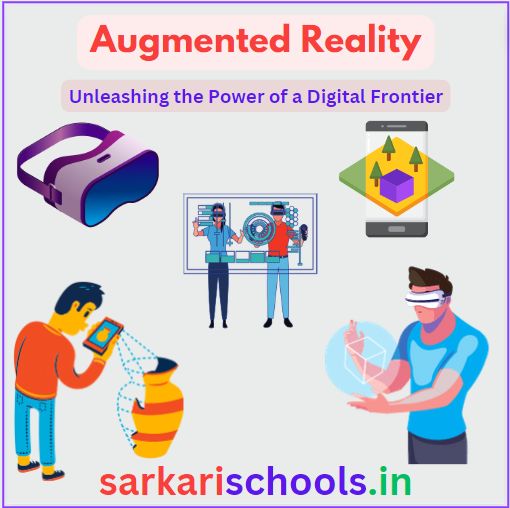
Augmented Reality is a technology that enhances our real-world experience by seamlessly blending digital information, such as graphics, videos, and 3D models, with our physical environment. It enriches our perception of reality, providing additional context and interactive elements.
II. How Augmented Reality Works:
- Sensors and Cameras: AR relies on sensors and cameras to capture real-time data about the environment, including location, motion, and visual information.
- Computer Vision: Advanced computer vision algorithms process the captured data to identify and understand the physical objects and their spatial relationships.
- Overlaying Digital Content: AR technology overlays digital content onto the real-world view, aligning it with the physical objects in real-time.
- Display and Interaction: Augmented reality content is typically viewed through devices like smartphones, tablets, smart glasses, or heads-up displays, allowing users to interact with the digital elements.
III. Augmented Reality Applications:
- Gaming and Entertainment:
- AR gaming has gained immense popularity, with applications like Pokémon Go introducing players to interactive virtual experiences in real-world environments. Additionally, AR is being used in interactive storytelling, museums, and amusement parks, providing immersive and educational experiences.
- Education and Training:
- Augmented reality has the potential to revolutionize education by bringing textbooks to life through interactive 3D models, enhancing science experiments, and providing virtual field trips. It also enables practical training scenarios in industries such as healthcare, aviation, and engineering.
- Retail and E-commerce:
- AR is transforming the retail landscape by offering virtual try-on experiences for clothing and accessories, enabling customers to visualize products in their own space through virtual placement, and providing additional product information and reviews.
- Industrial and Manufacturing:
- AR is being utilized in industrial settings to aid workers in tasks such as equipment maintenance and repair, assembly instructions, and real-time data visualization for process optimization. It enhances efficiency, reduces errors, and improves safety.
- Healthcare:
- In healthcare, AR is used for surgical planning, medical training, and patient education. It provides surgeons with real-time guidance and overlays patient information onto their field of view, improving accuracy and reducing risks.
IV. The Future of Augmented Reality:
The future of augmented reality holds significant potential for advancements and innovations:
- Wearable Devices:
- AR glasses and smart contact lenses are anticipated to offer more seamless and immersive augmented reality experiences, freeing users from the constraints of handheld devices.
- Spatial Mapping and Interaction:
- Improved spatial mapping capabilities will enable more accurate and realistic AR overlays, while advancements in gesture recognition and haptic feedback will enhance user interaction.
- Collaborative AR:
- Augmented reality can enable real-time collaboration among remote users, fostering teamwork and knowledge sharing across different locations.
V. Challenges and Considerations:
While augmented reality opens up exciting possibilities, several challenges need to be addressed:
- Hardware Limitations:
- The current limitations of devices, such as battery life, processing power, and form factor, need to be overcome to offer more seamless and immersive AR experiences.
- Privacy and Security:
- As AR relies on capturing and processing real-world data, ensuring privacy, data protection, and preventing unauthorized access become vital considerations.
- User Experience Design:
- Effective user experience design is crucial to create intuitive and meaningful AR interactions that seamlessly blend with the physical environment.
Conclusion:
Augmented reality has emerged as a transformative technology, offering innovative solutions across various industries. Its ability to merge the digital and physical realms opens up endless possibilities for enhancing entertainment, education, retail, healthcare, and industrial processes. As augmented reality continues to evolve and mature, it has the potential to reshape the way we perceive and interact with the world around us, unlocking new levels of engagement, efficiency, and creativity.