
Discover the inspiring journey of the First Female Doctor Anandi Gopal Joshi, who broke barriers and left a lasting legacy. Learn about her remarkable achievements and the impact she made in the field of medicine.
First Female Doctor Anandi Gopal Joshi
Anandibai Joshi, born on March 31, 1865, in Thane, British India, passed away at the age of 21 on February 1, 1887, in Pune, Bombay Presidency, British India. She was the first Indian woman born in the city of Pune to obtain a degree in medicine. She married Gopalrao Joshi at the age of nine and resided with him in Poughkeepsie, New York, United States.
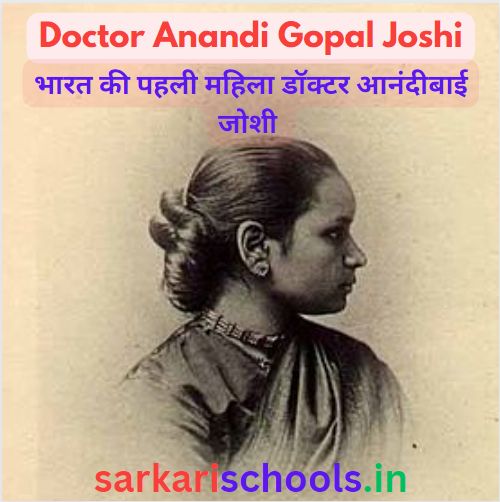
Anandibai Joshi received her degree from the Women’s Medical College of Pennsylvania, where she realized her dream of becoming a doctor for women. During that time, the level of education for women was very low, and her decision to pursue medical studies abroad exemplifies her courage. Her husband, Gopalrao Joshi, also provided her with complete support and bolstered her confidence.
Anandibai Joshi is considered an inspiration for women. In 1886, she gave shape to her dreams, but faced considerable criticism in society for a married Hindu woman studying medicine abroad. Nevertheless, Anandibai remained determined and unfazed by the opposition. She achieved the distinction of being the first Indian female doctor.
After completing her degree, when Anandibai returned to India, her health began to deteriorate, and her life span was greatly shortened. She passed away at the age of 22. Although the purpose for which she pursued her medical degree was not fully realized, she made significant progress in society, which remains an exemplary achievement today.
Educational Life
Gopalrao encouraged Anandibai to pursue a medical education. In 1880, he sent a letter to a renowned American missionary, Royal Wilder, expressing Anandibai’s interest in studying medicine in the United States and inquiring about suitable positions for himself. Wilder published their correspondence in his Princeton Missionary Review. Thodicia Carpenter, a resident of Roselle, New Jersey, read about it while waiting for her dentist. Moved by Anandibai’s desire to study medicine and supported by her husband Gopalrao, she offered Anandibai accommodation in the United States.
While the Joshis were in Calcutta, Anandibai’s health began to deteriorate. She suffered from weakness, constant headaches, occasional fevers, and breathing difficulties. Without any success, Theodicia sent her medicines from America. In 1883, Gopalrao was transferred to Serampore, and despite her fragile health, they decided to send Anandibai to America for medical studies, with Gopalrao encouraging her to serve as an example for other women by pursuing higher education.
A physician couple, the Thorborns, suggested that Anandibai apply to the Women’s Medical College of Pennsylvania. Upon learning about Anandibai’s plans for higher education in the West, conservative Indian society vehemently opposed her decision.
Anandibai addressed the community in the hall of Serampore College (West Bengal), explaining her decision to go to America and obtain a medical degree. She emphasized the need for female doctors in India and spoke about her goal of opening a medical college for women (Anandibai Medical College). Her speeches gained publicity, and financial contributions started pouring in from all over India.
In America
Anandibai Joshi embarked on a new chapter of her life by undertaking a journey from Kolkata to New York on a water vessel. Upon reaching New York, she received support and mentorship from Theodisia Carpenter, who facilitated her admission to the Women’s Medical College of Pennsylvania in June 1883. This program was the second-ever medical program for women in the world. Anandibai was enrolled and registered by the college’s dean, Rachel Bodley.
At the age of 19, Anandibai began her medical training. However, her health suffered due to the cold climate and unfamiliar food in America. Despite her ailments, she managed to graduate with an MD degree on March 11, 1885. Her thesis was titled “Obstetrics among Aryan Hindus.” Queen Victoria sent her a congratulatory message for her achievement.
In late 1886, Anandibai returned to India and received a grand welcome. The princely state of Kolhapur appointed her as the physician in charge of the women’s ward at the local Albert Edward Hospital. Tragically, at the young age of 22, Anandibai passed away on February 26, 1887, due to tuberculosis. Her death was mourned throughout India. Her ashes were sent to Theodisia Carpenter, who placed them in her family’s cemetery at Poughkeepsie Rural Cemetery in New York. It is stated in an inscription that Anandibai Joshi was the first Indian woman to receive an education and medical degree abroad, making her a pioneering Hindu Brahmin lady.
Return to India
In 1888, American feminist writer Caroline Wells Healey Dall wrote a biography of Anandibai Joshi. Dall was acquainted with Dr. Anandibai and held her in high regard. However, the biography included some points, particularly regarding Gopalrao Joshi’s harsh behavior, which sparked controversy among Joshi’s friends.
Doordarshan, an Indian public service broadcaster, aired a Hindi series called “Anandi Gopal” based on her life, directed by Kamalakar Sarang. Shrikant Joshi wrote a fictional account of her life in his Marathi novel “Anandi Gopal,” which was adapted into a play by Ram Ji Jogalekar under the same name.
Dr. Anjali Kirtane extensively researched Dr. Anandibai Joshi’s life and accomplishments and wrote a Marathi book titled “Dr. Anandibai Joshi Kal ani Kartutva” (“Dr. Anandibai Joshi: Her Time and Achievements”). The book also includes rare photographs of Dr. Anandibai Joshi.
In Lucknow, India, the Institute for Research and Documentation in Social Sciences (IRDS), a non-governmental organization, presents the Anandibai Joshi Award for Medicine in recognition of her early contributions to advancing medical science in India. Additionally, the Maharashtra government has established a fellowship in her name for young women working in women’s health.
In honor of her contributions, a pit in Shukra has been named “Joshi” after her, located at latitude 5.5°N and longitude 288.8°E.
On March 31, 2026, Google honored her on her 153rd birth anniversary with a Google Doodle.
In 2019, a Marathi film titled “Anandi Gopal” was made based on her life.