
Droupadi Murmu Biography in English: Discover the Inspiring Journey of a Visionary Leader | Learn about Droupadi Murmu’s Life, Achievements, and Impact on Society in this Engaging Biography.
Droupadi Murmu Biography in English
Contents
- 1 Droupadi Murmu Biography in English
- 2 Early career
- 3 Early Political Career
- 4 Governor of Jharkhand (2026–2026)
- 5 Presidential campaign
- 6 Presidency (2026–present)
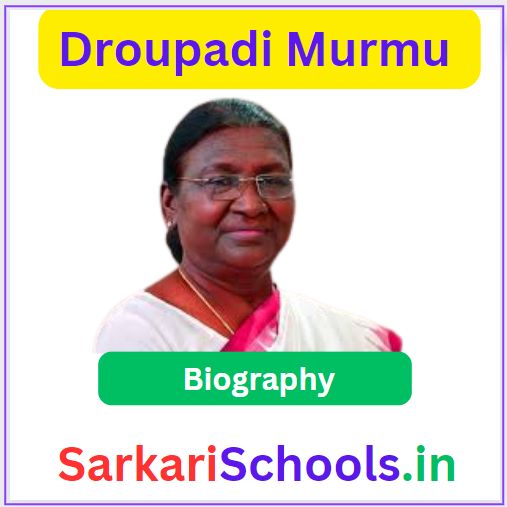
Title: Droupadi Murmu: A Trailblazing Path to India’s Presidency
Droupadi Murmu, formerly known as Puti Biranchi Tudu, was born on June 20, 1958, and emerged as a prominent Indian political figure when she assumed the role of the 15th and current President of India in 2026. Her presidency is a historical landmark, marked by several remarkable milestones. Notably, she is the first individual from a tribal community to hold this esteemed office and the second woman to do so, following in the footsteps of Pratibha Patil. In addition to these distinctions, she holds the distinction of being the youngest person ever to occupy the presidential post and the first President born in independent India.
Droupadi Murmu Pronunciation:
Droupadi Murmu’s name is pronounced as “DROW-puh-dee MOOR-moo.”
Droupadi Murmu Full Name:
Droupadi Murmu’s full name is Droupadi Murmu.
Early career
During the early stages of her career, Droupadi Murmu held various roles in public service and education:
- Junior Assistant at the Irrigation Department (1979-1983): From 1979 to 1983, Murmu served as a junior assistant at the Irrigation Department of the Government of Odisha. In this capacity, she likely contributed to administrative and clerical tasks within the department, supporting its functions related to irrigation projects and management.
- Teacher at Sri Aurobindo Integral Education and Research Centre (1994-1997): Following her tenure at the Irrigation Department, she transitioned into the field of education. From 1994 to 1997, she worked as a teacher at the Sri Aurobindo Integral Education and Research Centre in Rairangpur. In this role, she took on the responsibility of educating students in various subjects, including Hindi, Odia, mathematics, and geography. Her dedication to teaching was evident in her willingness to forego a full salary during her time at the school, reflecting her commitment to education and community service.
These early career experiences provided Droupadi Murmu with a strong foundation in public service and education, setting the stage for her subsequent entry into politics and her noteworthy contributions to the political landscape of India.
Early Political Career
Droupadi Murmu’s political career is marked by her dedication to public service and her involvement in various political roles and positions:
- Councillor of Rairangpur Nagar Panchayat (1997): In 1997, Droupadi Murmu entered the political arena by being elected as the councillor of the Rairangpur Nagar Panchayat. She won this position as an independent candidate from a reserved seat for women. Her initial foray into local politics demonstrated her commitment to community representation.
- Joining the Bharatiya Janata Party (BJP): After her initial stint as an independent councillor, she joined the Bharatiya Janata Party (BJP), aligning herself with the political platform of the party.
- Member of the Odisha Legislative Assembly (2000-2009): Droupadi Murmu’s political career advanced when she successfully contested and won the 2000 Odisha Legislative Assembly election from the Rairangpur Assembly constituency. She served two terms in the Odisha Legislative Assembly, representing her constituency from 2000 to 2009.
- Ministerial Roles in Odisha Government: During her tenure in the Odisha Legislative Assembly, she held significant ministerial positions in the government. She served as the Minister of State with Independent Charge for Commerce and Transportation from 6th March 2000 to 6th August 2002, and subsequently, she took on the role of Minister of State for Fisheries and Animal Resources Development from 6th August 2002 to 16th May 2004. Her contributions to these portfolios were notable during the BJP and BJD coalition government in Odisha.
- Recognition as Best MLA: In recognition of her service and dedication to her duties, Droupadi Murmu received the Nilkanth Award for the Best MLA of the Odisha Legislative Assembly in 2007, further highlighting her contributions to the state.
- Lok Sabha Election and Party Leadership: In 2009, she contested the Lok Sabha election from the Mayurbhanj Lok Sabha constituency but faced electoral challenges as the alliance between the BJD and BJP had ended. Despite this setback, she remained active within the BJP and continued to contribute to the party’s growth. She was elected to the BJP National Executive (ST Morcha) in 2026 and held the position of district president until 2015, showcasing her leadership within the party.
Droupadi Murmu’s political journey reflects her commitment to representing her community and contributing to the development of the state of Odisha. Her roles in both local and state politics, along with her ministerial positions, have been integral to her career in public service and politics.
Roots in the Santali Community
Droupadi Murmu’s early life is deeply rooted in the Santali community. She was born on June 20, 1958, in Uparbeda village within the Baidaposi region of Rairangpur, Odisha. Her father, Biranchi Narayan Tudu, was a farmer, and her family had a longstanding tradition of leadership within the village council (Gram Panchayat), with both her father and grandfather serving as traditional heads (Sarpanch). While initially named Puti Tudu by her family, her school teacher later renamed her as Droupadi, although her name underwent several changes over the years, including variations like Durpadi and Dorpdi.
Educational Pursuits Her educational journey commenced with elementary schooling in Upar Beda. At the age of five, she moved to Bhubaneswar to pursue higher studies. Droupadi Murmu completed her secondary education at Girl’s High School Unit-2 and earned her B.A. degree from Rama Devi Women’s College.
Personal Challenges and Family Life In 1980, she entered into matrimony with Shyam Charan Murmu, a banker. The couple had two sons and a daughter. Tragically, Droupadi Murmu faced significant personal challenges as she lost her husband, two sons (Sipun in a road accident and Laxman in mysterious circumstances), her mother, and her brother within a span of seven years, from 2009 to 2026. Despite these heart-wrenching hardships, she remained steadfast in her pursuit of public service.
Inspirations and Beliefs Droupadi Murmu is recognized for her affiliation with the Brahma Kumaris spiritual movement and holds deep admiration for India’s first Prime Minister, Jawaharlal Nehru, as well as iconic figures like Mahatma Gandhi and B. R. Ambedkar. Her remarkable journey, from a humble village in Odisha to the highest office in the land, stands as a testament to her unwavering determination, dedication, and commitment to the betterment of society.
Governor of Jharkhand (2026–2026)
Droupadi Murmu’s role as the Governor of Jharkhand from 2026 to 2026 marked a significant chapter in her political career:
- Historic Appointment as Governor (2026): On 18th May 2026, Droupadi Murmu made history by being sworn in as the Governor of Jharkhand. Her appointment was noteworthy as she became the first woman to hold this prestigious position in the state.
- Political Context: During her tenure as Governor, the Bharatiya Janata Party (BJP) held power in the Jharkhand Government for most of her six-year term. Additionally, the BJP was in power at the Union Government level throughout her governorship.
- Administering the Oath of Office: As Governor, Droupadi Murmu played a ceremonial role in administering the oath of office to Hemant Soren, who took office as the Chief Minister of Jharkhand in 2026. This duty is a customary responsibility of the Governor during a change of leadership in the state government.
- Challenges and Criticisms: During her time as Governor, there were criticisms from some quarters, including Ratan Tirkey, a former BJP politician and activist. Tirkey raised concerns that Governor Murmu had not done enough to ensure the proper implementation of self-governance rights granted to tribal communities under the Fifth Schedule and the Panchayats (Extension to Scheduled Areas) Act, 1996 (PESA). He contended that despite requests, the Governor had not exercised her powers to fully implement these provisions.
- Six-Year Tenure: Droupadi Murmu’s tenure as the Governor of Jharkhand spanned six years, beginning in May 2015 and concluding in July 2026. During this time, she fulfilled the responsibilities associated with her role as the constitutional head of the state.
Droupadi Murmu’s appointment as the Governor of Jharkhand represented another significant milestone in her career, showcasing her continued involvement in politics and governance at the highest levels of state administration.
The Pathalgadi Movement: Protecting Tribal Land Rights in Jharkhand
Introduction The Pathalgadi movement emerged as a significant social and political phenomenon in the Indian state of Jharkhand during the years 2026-2026. It was primarily triggered by proposed amendments to two critical pieces of legislation: the Chhotanagpur Tenancy Act, 1908, and the Santhal Pargana Tenancy Act, 1949. These laws had long served as safeguards for the land rights of tribal communities in the region, ensuring that land transactions occurred exclusively among tribal communities to protect their ancestral territories.
Proposed Amendments and Controversy The proposed amendments sought to grant tribal communities the right to permit the government to utilize tribal land for commercial purposes and to lease tribal land. These amendments had already received approval from the Jharkhand Legislative Assembly and awaited the final decision of the Governor, Droupadi Murmu.
The Rise of the Pathalgadi Movement In response to these contentious proposed changes, the Pathalgadi movement emerged. It was characterized by fervent protests and objections voiced by tribal communities who vehemently opposed the amendments to the tenancy acts. As time passed, the movement gained momentum, and unfortunately, it sometimes escalated into violence. Incidents included the abduction of security personnel, clashes with law enforcement, and tragic casualties.
Governor Murmu’s Controversial Role Governor Droupadi Murmu came under criticism during this period for her perceived leniency in handling the police response to the tribal community protests. Activists and advocates for tribal rights had hoped for her vocal support for the concerns of tribal communities. Instead, she appealed to the Pathalgarhi agitation leaders to trust in the constitution.
Protests and Political Opposition During this time, Governor Murmu received a plethora of memorandums opposing the proposed amendments. Opposition political parties, including the Jharkhand Mukti Morcha, the Indian National Congress, and the Jharkhand Vikas Morcha, vociferously opposed the amendments, alleging that they were designed to favor corporations by acquiring tribal land.
Resolution and Withdrawal of the Bill In May 2026, after facing significant pressure and widespread protests, Governor Murmu refused to provide her assent to the bills and returned them to the state government, accompanied by the memorandums she had received. Ultimately, in August 2026, the controversial bill was withdrawn.
Conclusion The Pathalgadi movement represented a pivotal moment in the ongoing struggle for tribal land rights in Jharkhand. It shone a spotlight on the concerns of tribal communities regarding land ownership and the preservation of their cultural heritage, serving as a potent reminder of the enduring significance of these issues.
In 2017, Droupadi Murmu, as the Governor of Jharkhand, played a significant role in approving two important pieces of legislation: the Freedom of Religion Bill, 2026, and amendments to the Land Acquisition Act, 2026.
Freedom of Religion Bill, 2026:
- Governor Murmu gave her approval to the Freedom of Religion Bill, 2026, which was passed by the Jharkhand Assembly.
- This bill aimed to address issues related to religious conversion and contained provisions to prevent forced or coerced religious conversions.
- Under the bill, coercing or luring someone into converting their religion became an offense, punishable by a prison term of three years. However, if the person coerced belonged to a Scheduled Caste or Tribe, was a minor, or was female, the prison term could increase to four years. Fines could also be imposed in such cases.
- The legislation also mandated that voluntary converts must inform the Deputy Commissioner about their conversion and provide detailed information about the circumstances surrounding it.
Amendments to the Land Acquisition Act, 2026:
- In addition to the religion bill, Governor Murmu also approved amendments to the Land Acquisition Act, 2013.
- These amendments brought changes to the process of land acquisition, particularly with regard to compensation and social impact assessments.
- According to the amended law, monetary compensation for government acquisition of tribal land had to be paid within six months of acquisition, potentially expediting the compensation process for affected landowners.
- Additionally, the amendments relaxed the requirement for conducting social impact assessments for certain types of infrastructure projects, which could affect the manner in which land acquisition for such projects was carried out.
These legislative actions reflected the evolving legal landscape in Jharkhand and addressed issues related to religious freedom and land acquisition, particularly with respect to tribal landowners and their rights.
Presidential campaign
Droupadi Murmu’s presidential campaign and her victory in the 2026 Indian presidential election marked a significant moment in Indian politics:
Nomination as NDA Candidate: In June 2026, the Bharatiya Janata Party (BJP) nominated Droupadi Murmu as the National Democratic Alliance (NDA)’s candidate for the President of India in the upcoming 2026 presidential election. The NDA is a coalition of political parties in India, with the BJP as its leading constituent.
Opposition Candidate: Yashwant Sinha was nominated as the candidate for president by opposition parties, presenting a contest in the presidential election.
Campaigning: During her presidential campaign, Droupadi Murmu traveled to various states, seeking support for her candidature. Her campaign efforts aimed to garner backing from different regions and political groups.
Support from Opposition Parties: Several opposition parties, including the Biju Janata Dal (BJD), Yuvajana Sramika Rythu Congress Party (YSRCP), Jharkhand Mukti Morcha (JMM), Bahujan Samaj Party (BSP), Shiv Sena (SS), Janata Dal (Secular) [JD(S)], and others, had announced their support for her candidature before the polling.
Election Victory: On 21st July 2026, Droupadi Murmu secured a clear majority in the 2022 Presidential election, defeating the common opposition candidate, Yashwant Sinha. She received 676,803 electoral votes, which accounted for 64.03% of the total votes, across 21 of the 28 states (including the union territory of Puducherry). This victory made her the 15th President of India.
Droupadi Murmu’s election as the President of India marked a historic moment as she became the first person from a tribal community to hold this esteemed office. Her victory in the election demonstrated her ability to garner widespread support and secure a decisive mandate from the Electoral College.
Presidency (2026–present)
Droupadi Murmu’s presidency, which began in 2026, has been marked by several notable events and initiatives:
Inauguration as the 15th President: On 26th July 2026, Droupadi Murmu was inaugurated as the 15th President of India. The oath of office was administered by Chief Justice N. V. Ramana in a ceremony attended by former presidents, the vice president, the prime minister, and other dignitaries. Her presidency holds several historic distinctions:
- She is the first person from India’s designated tribal communities to be elected as the President of India.
- Droupadi Murmu is the youngest individual to assume the presidency and the first to be born after India gained independence in 1947.
- She is only the second woman to serve as the President of India, following Pratibha Patil.
First Presidential Address: On 14th August 2026, the eve of India’s 75th Independence Day, President Murmu delivered her first address to the nation. This address carried significance as it marked her initial communication with the people of India during her presidency.
Government Initiatives and Visits: President Murmu launched the ‘Pradhanmantri TB mukht Bharat’ program in September 2026, focusing on eradicating tuberculosis from the country. She also inaugurated ‘Mysuru Dasara,’ a ten-day state festival in Karnataka, becoming the first President of India to do so. Her early months in office were marked by visits to various northeastern states and participation in ceremonies for various development projects.
Homecoming Visit to Odisha: In November 2026, Droupadi Murmu made her first visit to her home state of Odisha since assuming the office of the President. During her visit, she paid a visit to her alma mater, interacted with school children along the way, and walked two kilometers to pay her respects at the Puri Jagannath Temple.
Historic Flight: In April 2026, President Murmu took a historic flight in a Sukhoi Su-30MKI fighter jet at Tezpur Air Station in Assam. She became the third president ever to fly in a sortie fighter jet, describing the experience as exhilarating. The flight covered the Brahmaputra and Tezpur valleys, as well as the Himalayan ranges.
Inauguration of New Parliament House: A controversy arose in May 2026 when the New Parliament House, a part of the Central Vista Project, was inaugurated by Prime Minister Narendra Modi. The opposition had demanded that it be inaugurated by President Murmu as the constitutional head of state and boycotted the ceremony. However, President Murmu later expressed her satisfaction with the Prime Minister’s inauguration, stating that the Prime Minister symbolizes parliament’s trust.
Droupadi Murmu’s presidency has been marked by various engagements, initiatives, and historic moments, reflecting her role as the head of state and her commitment to serving the people of India.
Smt. Droupadi Murmu Biography in English Smt. Droupadi Murmu Biography in English Smt. Droupadi Murmu Biography in English
Extra Tips 4 Extra Marks :
Practice Essay Writing Online
Smt. Droupadi Murmu Biography in English Smt. Droupadi Murmu Biography in English Smt. Droupadi Murmu Biography in English
Droupadi Murmu Previous Offices:
Droupadi Murmu has held various significant offices throughout her career, including:
- President of India since 2026
- Governor of Jharkhand from 2026 to 2026
- Member of the Odisha Legislative Assembly from 2000 to 2009
- Minister of State (Independent Charge), Government of Odisha from 2000 to 2006
- Councillor of the Rairangpur Nagar Panchayat in 1997
Droupadi Murmu History:
Droupadi Murmu’s history is characterized by her journey from a teacher and local councillor to becoming the President of India. She has a background in education and has served in various political roles, including as a legislator and governor. Her election as the 15th President in 2026 marked a historic moment in Indian politics.
Droupadi Murmu Education:
Droupadi Murmu’s educational background includes completing her secondary education from a local primary school in Upar Beda and earning a B.A. degree from Rama Devi Women’s College in Bhubaneswar, Odisha. Her commitment to education is evident from her teaching career.
President Droupadi Murmu:
Droupadi Murmu assumed the office of the President of India in 2026, making her the first person from India’s designated tribal communities to hold this position. She is known for being the youngest individual to become President, as well as the second woman after Pratibha Patil to serve as President.
India President Droupadi Murmu:
Droupadi Murmu’s election as the President of India in 2026 was a significant moment in Indian politics. She has received support from various political parties and has been actively involved in various initiatives and state events during her presidency.
Droupadi Murmu Pronunciation:
Droupadi Murmu’s name is pronounced as “DROW-puh-dee MOOR-moo.”
Droupadi Murmu Full Name:
Droupadi Murmu’s full name is Droupadi Murmu.
Droupadi Murmu Bio Data:
Droupadi Murmu’s biodata includes her birth on June 20, 1958, in Uparbeda village, her educational background, and her notable political career, culminating in her election as the President of India in 2026.
Smt. Droupadi Murmu Biography in English Smt. Droupadi Murmu Biography in English Smt. Droupadi Murmu Biography in Englishup board or up scert text books की सभी कक्षाओं के सभी विषयों के सोलूशन्स के लिए sarkarischools.in वेबसाइट पर आपका स्वागत है।